


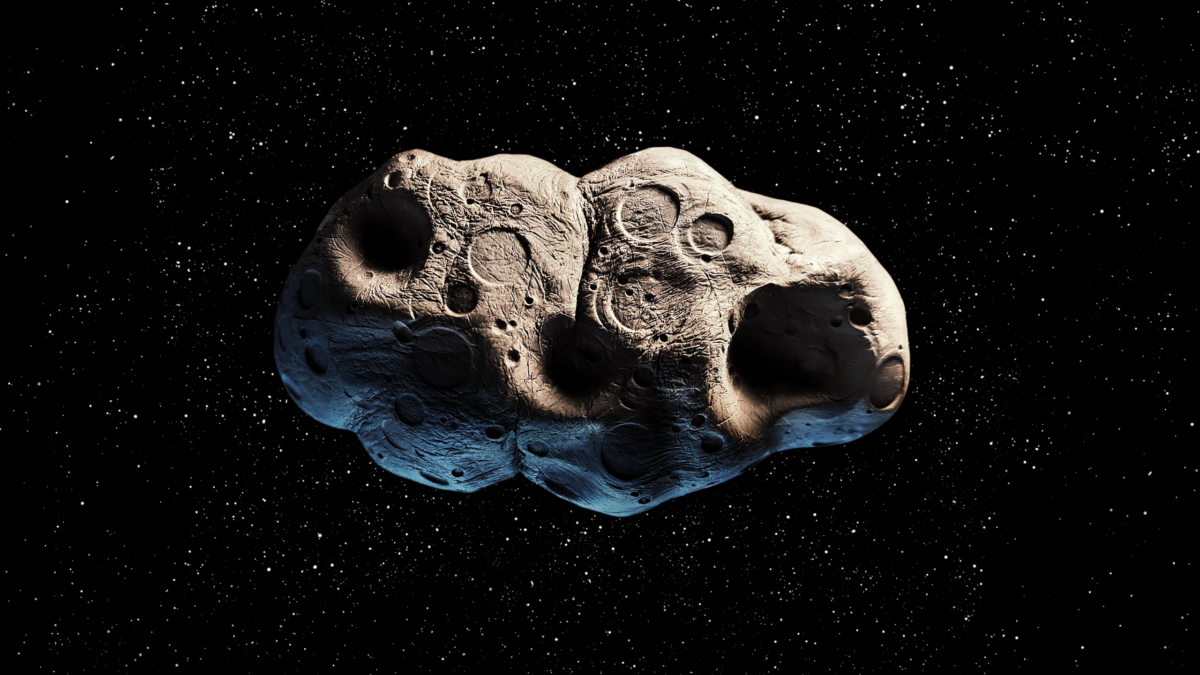
The Unusual Behavior of Asteroid 1998 KY26: Is It Really a ‘Dark’ Comet?
In the vast expanse of our solar system, most asteroids follow predictable paths, governed primarily by gravity and solar radiation. However, asteroid 1998 KY26 exhibits behavior that has puzzled scientists, defying conventional expectations. Unlike its more compliant counterparts, KY26 is displaying accelerative characteristics that suggest a complexity beyond a standard asteroid.
The ‘Dark Comet’ Hypothesis
One particular theory proposes that KY26 might not be a typical asteroid at all. Instead, it may be a ‘dark comet’, which would imply that it is emanating gas without the visual hallmark of a comet’s tail. This hypothesis centers around the idea that the asteroid could be subtly pushing itself along its orbit due to outgassing ice from beneath its surface, which would be undetectable by conventional means.
New Findings Challenge Previous Assumptions
Recent research by aerospace engineers Korbin Hansen and Masatoshi Hirabayashi at the Georgia Institute of Technology casts doubt on this theory. Their study indicates that 1998 KY26 is likely too warm to retain the essential ice that supports outgassing.
“Our temperature model results indicate that the water outgassing rate on 1998 KY26 would be too high to maintain buried ice, refining the understanding of the asteroid’s composition,” they state in their published paper in the journal Icarus.
Temperature Analysis of KY26
Asteroids and comets are both classified into broad categories based on their composition. Comets, consisting of ice, can produce gas as their icy components sublime—a process that provides propulsion beyond gravitational forces. However, Hansen and Hirabayashi modeled the temperature of KY26, using data on its size, orbit, and surface characteristics.
The researchers found that for ice to subsist effectively, it must remain at temperatures below approximately 145 Kelvin (-128 degrees Celsius). They discovered that KY26’s average temperature is around 212 Kelvin (-61 degrees Celsius), a reading that poses a significant challenge to the notion of it housing ice.
Potential Origins of the Acceleration
According to their calculations, if KY26 contained even one percent water ice, it would completely vaporize in just over 2,000 years, with a considerably quicker disappearance in around 62 years if it was solely responsible for the asteroid’s unusual acceleration.
While KY26 might have existed for billions of years, it remains uncertain how long it has maintained its current orbit, leaving open the possibility of hidden ice. Nevertheless, the research trends suggest that this scenario is increasingly unlikely.
Looking Ahead: Future Exploration
So, what force is causing KY26 to deviate from its expected trajectory? A strong contender is the radiation pressure from the Sun. The slight yet significant forces exerted by sunlight could be instrumental in its unexpected motions.
Excitingly, the Japanese space agency’s Hayabusa2 spacecraft is on a mission to rendezvous with KY26, scheduled for July 2031. This upcoming dialogue between the spacecraft and the asteroid may reveal new insights into its true nature.
As we await the findings from Hayabusa2, the mystery of 1998 KY26 continues to intrigue astronomers, challenging our understanding of celestial bodies in our solar system.
