


Insight into China’s Reusable Spaceplane: DIA Report Overview
Overview of the DIA Report
In a recent report published on October 26, 2026, the U.S. Defense Intelligence Agency (DIA) has provided an insight into China’s reusable spaceplane activities between 2020 and 2023. This report, titled “Challenges to Security in Space,” highlights the Chinese spacecraft’s missions, especially focusing on its rendezvous and proximity operations that occurred during its second and third flights.
Latest Imaging and Mission Details
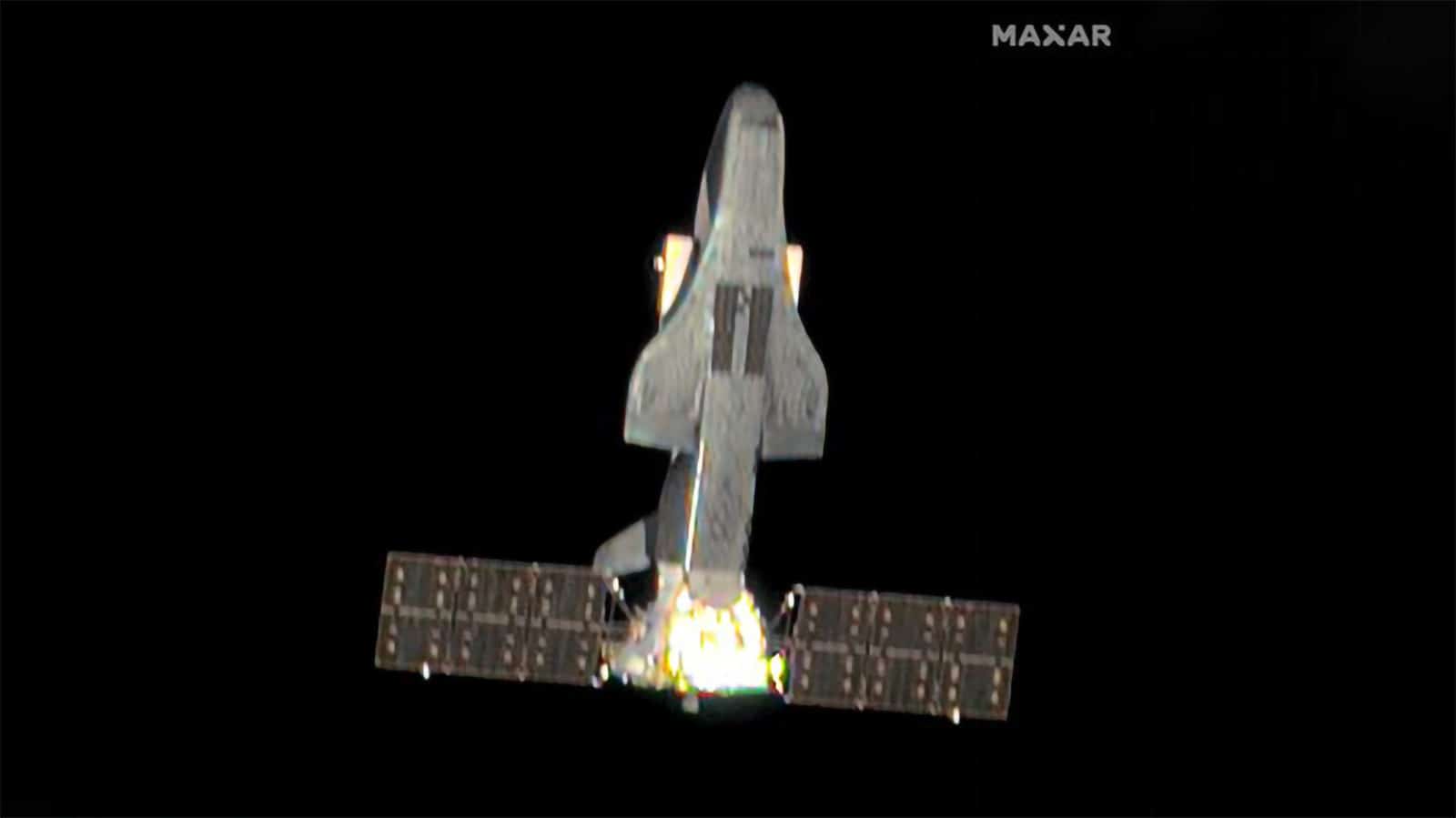
A notable feature of the DIA report is the inclusion of a photograph obtained from Maxar Technologies, which shows the Chinese spaceplane in orbit with its service module operational. This image, captured in 2024, represents one of the rare instances of clear imagery available for this secretive spacecraft.
Since its first launch on September 4, 2020, the spacecraft has completed a total of four missions via Long March 2F rockets. Here is a summary of its orbital missions:
- First Mission: September 2020 – Duration: 2 days
- Second Mission: August 4, 2022 – Duration: 276 days
- Third Mission: December 14, 2023 – Duration: 268 days
- Fourth Mission: Began in February 2026
Missions Under Analysis
Throughout its missions, particularly the second and third, the spacecraft was observed engaging in multiple close approaches to another object. Space tracking forums noted these maneuvers, although prior to the release of the Maxar image in 2024, public perceptions were primarily shaped by low-resolution imagery and hypothetical models.
For example, during the second mission, the spacecraft displayed capabilities for significant maneuvers alongside a companion satellite and engaged in operations that included docking and retrieval. Reports indicated that at times, the two objects were within 100 meters of one another, suggesting advanced operational capabilities.
Capabilities and Comparisons
The DIA report identifies two models of the Chinese spacecraft, named Shenlong and Tengyun, although it remains unclear which specific model exists in the captured image. Observers often compare China’s spaceplane to the U.S. Space Force’s X-37B due to their similar functions as uncrewed, reusable orbital vehicles.
Despite the visible technological advancements, details regarding payload specifications and mission objectives for the Chinese spacecraft are limited. Additionally, its capabilities may extend to potential military applications, including satellite inspection, reconnaissance, and even possible counter-space operations.
Future Prospects and Applications
The ambiguity surrounding the purpose of the Chinese spaceplane raises questions within the defense community. While no definitive evidence currently categorizes the vehicle as a kinetic anti-satellite weapon, its capacity for proximity operations could be leveraged for both civil and military applications. There is speculation regarding its role in space-based surveillance, intelligence-gathering missions, and other strategic applications.
China has publicly downplayed any military implications, framing the spacecraft’s missions as test flights aimed at advancing technology for peaceful use in space. A statement from a Xinhua report regarding the spacecraft’s second mission noted an intention to verify reusable technology, asserting a commitment to the non-military utilization of space.
Conclusion
The DIA report illustrates a growing concern regarding capabilities in space among strategic rivals, emphasizing the importance of understanding advances in space technology. With China’s burgeoning prowess in orbital capabilities, analyzing the implications of its reusable spaceplane will be crucial for future space security assessments and defensive strategies.