


Hera Mission Approaches Didymos: Analyzing the Aftermath of Impact
Two years following its launch, the European Space Agency’s (ESA) Hera spacecraft is nearing its target: the Didymos asteroid system. Recently, Hera transmitted its first close-up images, providing an unprecedented view of the asteroid.
New Perspectives on Didymos
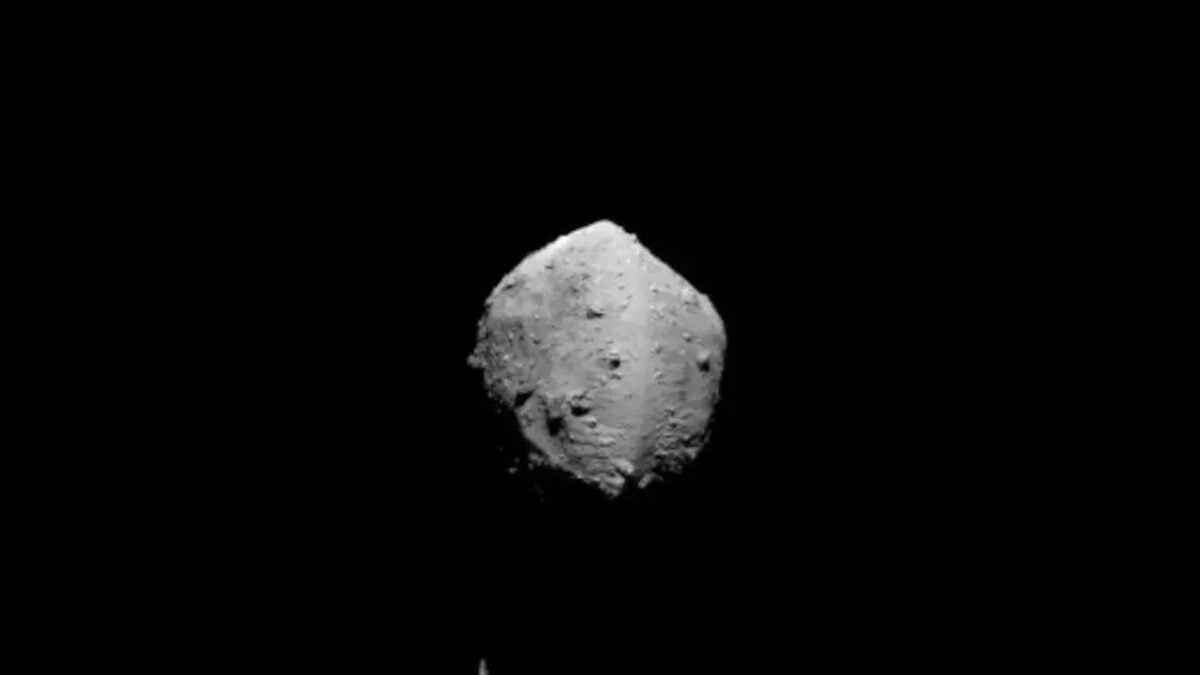
Captured from approximately 37 miles (60 kilometers) away, the black-and-white images of Didymos reveal a side previously unseen by NASA’s Dart spacecraft. Notably, features visible in this new perspective include various boulders, craters, and patterns suggesting post-impact geological activity.
“The first thing we said was wow!” said Patrick Michel, Hera’s principal investigator. “This feels like looking at a whole new world.”
NASA’s DART Mission: A Catalyst for Hera’s Investigations
The context for Hera’s investigation stems from NASA’s Double Asteroid Redirection Test (DART) mission, which intentionally crashed a spacecraft into Dimorphos, Didymos’s smaller companion, in September 2022. This impact altered Dimorphos’s orbital period from 11 hours and 55 minutes to 11 hours and 23 minutes, confirming the mission’s success.
The Role of Hera
Launched on October 7, 2024, Hera embarks on its vital role as a follow-up to DART. With a two-year journey complete, the spacecraft is poised to gather data aimed at assessing the impact’s full repercussions and evaluating potential strategies for planetary defense. The mission will involve extensive analysis of both Didymos and Dimorphos.
Insights from Recent Images
The recently obtained images display Didymos’s hidden side, highlighting its unique features. According to Michel, while a central ridge along the equator of Didymos remains consistent, the rest of the surface showcases distinct characteristics, including:
- Multiple boulders
- Craters
- Patterns of grooves or ridges
These characteristics may have resulted from the collision, with debris likely scattered across the 0.6-mile (1 kilometer) gap between Didymos and Dimorphos.
A Detailed Exploration Ahead
While the image captures only a sliver of Dimorphos below Didymos, Hera is expected to conduct detailed observations for at least six months. Michael Kueppers, ESA’s mission scientist for Hera, expressed enthusiasm about the work ahead. He emphasized the anticipation surrounding the systematic mapping of changes observed on both bodies:
“We look forward to seeing much more of both bodies and [systematically] mapping all the changes we identify.”
With critically important data on the horizon, Hera’s findings will significantly contribute to our understanding of asteroid impacts and planetary defense strategies.
