


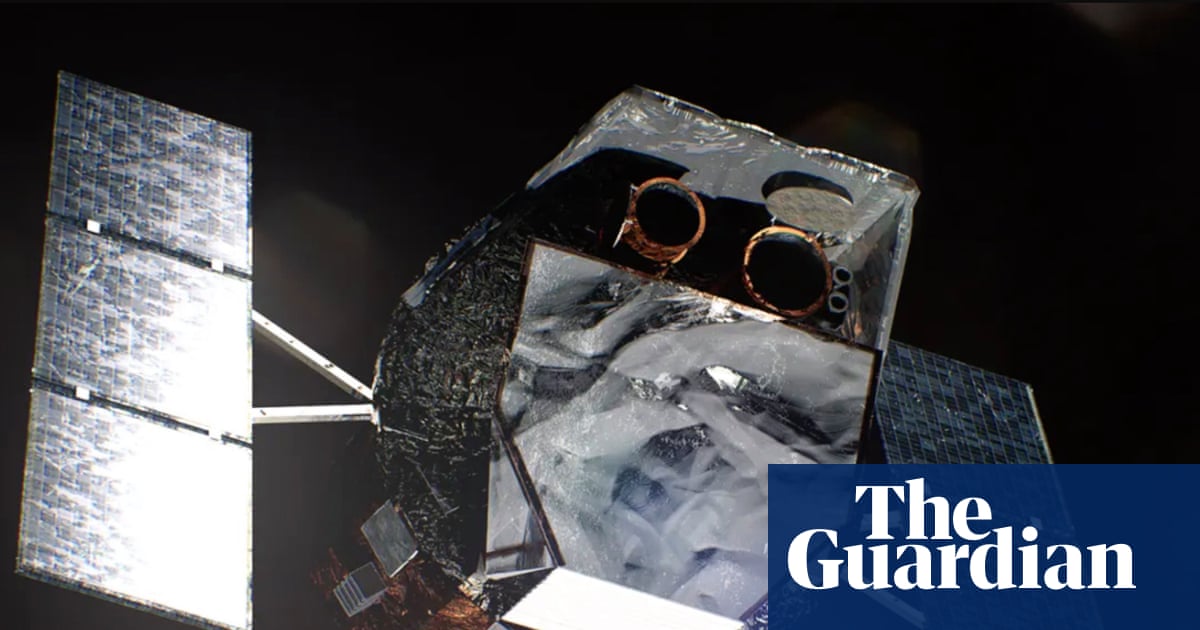
Nasa’s Swift Observatory Prepares for Re-Entry into Earth’s Atmosphere
Swift Observatory: A Legacy of Cosmic Discovery
The Neil Gehrels Swift Observatory, a satellite launched by NASA in 2004, has observed the universe’s most powerful explosions, known as cosmic gamma-ray bursts (GRBs), for nearly two decades. Designed for a two-year operational lifespan, Swift has significantly exceeded expectations by providing crucial insights into these astronomical phenomena.
Upcoming Re-Entry Details
NASA announces that the observatory is expected to re-enter Earth’s atmosphere on November 4 at approximately 3:30 AM ET. This re-entry is projected to be uncontrolled due to the satellite’s inability to steer or observe as it will burn up upon entry. The US Space Force estimates that while most of the 3,200 lb spacecraft will disintegrate, some components may survive.
- The re-entry location for any surviving fragments is expected to be limited to a band between 20.6 degrees south and 20.6 degrees north latitude.
- The likelihood of harm resulting from any surviving debris is low, approximately 1 in 2,100 according to NASA.
Scientific Contributions and Findings
Over its operational life, Swift has successfully detected and tracked more than 2,000 GRBs, contributing to our understanding of these energetic explosions. Scientists theorize that GRBs may arise from various cosmic events, including the birth of a black hole during a massive stellar explosion or the collision of neutron stars.
Nasa’s Swift Observatory has helped in expanding our knowledge not only of gamma-ray bursts but also of other cosmic phenomena, such as active galaxies and supernovae. Its recent observations, including a star being torn apart by a supermassive black hole, exemplify its capability to document extraordinary celestial events.
Tidal Disruption Events and Black Holes
In its last noteworthy observation in July, Swift captured images of a “tidal disruption event,” where a wandering black hole consumed a star nearing it, emitting a significant glow. According to the agency, this event temporarily outshone its entire host galaxy, radiating with the light of approximately 10 billion suns. Such occurrences are rare, typically happening about once every 100,000 years in galaxies.
The Future of Swift’s Data
Although Swift’s re-entry signals the end of its mission, the data it collected will continue to provide invaluable information for astronomers seeking to understand the complex mechanics of the universe. NASA’s attempts to extend the observatory’s life by altering its orbit were unsuccessful, but the insights gained from its operational history will continue to resonate in the field of astrophysics.
