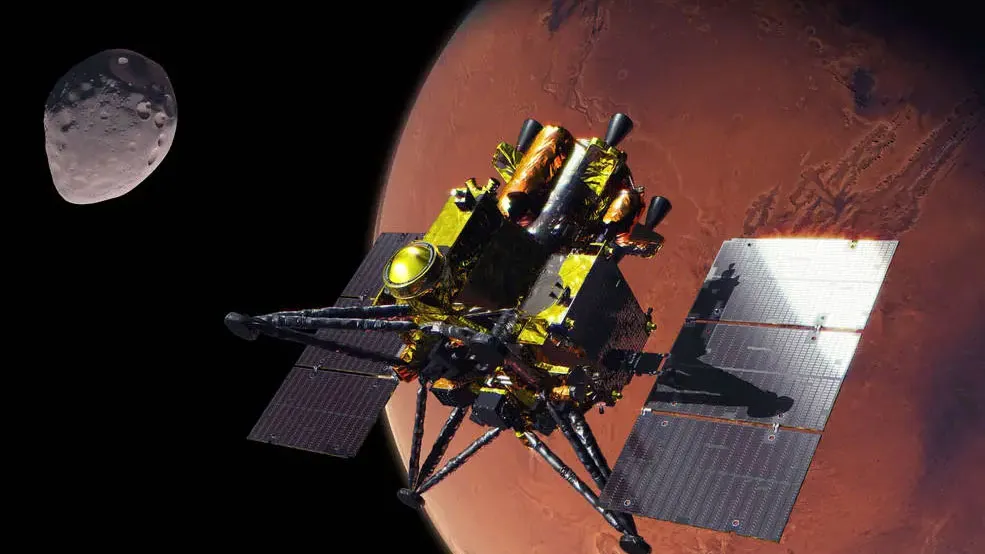
Japan’s Martian Moons eXploration (MMX) Mission: A Groundbreaking Endeavor to Learn About Mars’ Moons
<p>Japan is set to embark on its most ambitious space exploration initiative yet: the Martian Moons eXploration (MMX) mission. This groundbreaking venture aims not only to be the first to return samples from Mars' orbit but also to investigate the origins of the planet's two moons, Phobos and Deimos.</p>

<h2>Mission Overview</h2>

<p>Scheduled for launch on October 19, 2026, the MMX spacecraft will take off aboard an H3 rocket from the Tanegashima Space Center in Japan. Following a 10-month journey, the spacecraft will reach Mars in August 2027. It will then conduct an extensive examination of Phobos, where it will deploy a rover to collect geological samples. After spending around three years studying Phobos, MMX will shift its focus to Deimos, conducting flybys before beginning its journey back to Earth in November 2030, with a planned landing in Australia in 2031.</p>

<h2>The Spacecraft Components</h2>

<p>The MMX spacecraft consists of three primary modules along with a small rover named IDEFIX, a nod to the popular French comic. Built by Mitsubishi Electric, the modules include:</p>

<ul>
    <li><strong>Propulsion Module:</strong> Responsible for the initial trajectory to Mars.</li>
    <li><strong>Exploration Module:</strong> Houses scientific instruments and the IDEFIX rover.</li>
    <li><strong>Return Module:</strong> Contains the sample-return capsule.</li>
</ul>

<h2>Scientific Tools and Goals</h2>

<p>The exploration module of MMX encompasses various instruments designed to analyze the surface composition and geography of Phobos. Notable components include:</p>

<ul>
    <li>MEGANE: A gamma-ray and neutron spectrometer developed by NASA, aimed at studying elemental compositions.</li>
    <li>MIRS: A spectrometer from France focused on infrared analysis to identify surface materials.</li>
    <li>IDEFIX Rover: Equipped with high-resolution cameras and spectrometers to conduct on-site analyses.</li>
</ul>

<h2>Mission Phases</h2>

<p>Upon entering Mars' orbit, MMX will enter a quasi-satellite orbit around Phobos, facilitating extended studies. Initial observations will target potential landing areas, followed by two separate collection attempts to retrieve samples from the moon's surface. Each collection method will extract at least 10 grams of Phobos material, which will be contained within the return capsule for the journey back to Earth.</p>

<h2>Understanding Phobos and Deimos</h2>

<p>Both of Mars' moons are enigmatic and bear similarities to D-type asteroids, suggesting they may have been captured by Mars' gravity rather than forming alongside it. Two prevalent theories concerning their origins include:</p>

<ul>
    <li>**Asteroid Capture:** Suggests that these moons originated in the asteroid belt before being captured by Mars.</li>
    <li>**Impact Formation:** Proposes that a colossal impact on ancient Mars expelled debris that coalesced to form the moons, akin to Earth's moon formation.</li>
</ul>

<h2>Scientific Implications</h2>

<p>The samples returned by MMX could provide unprecedented insights into the composition and geological history of both moons. This information may help clarify the evolutionary paths of Mars and its moons, offering clues about their origins and the processes that shaped the planets in our solar system. "The Phobos samples will be historic," stated Tom Statler, MMX program executive. "They have the potential to answer questions we cannot yet anticipate."</p>

<h2>International Collaboration</h2>

<p>The MMX mission illustrates a significant international effort, with contributions from NASA and the European Space Agency (ESA). NASA's involvement includes scientific payloads and financial investment, which will ensure that a portion of the samples returned will be allocated for analysis within U.S. laboratories.</p>

<p>With its ambitious objectives and innovative scientific approach, Japan's MMX mission is poised to enhance our understanding of Mars' moons and potentially revolutionize our comprehension of the solar system's formation.</p>