


Advancements in AI: The FLIP Model for Enhanced Planetary Imaging
Recent developments in artificial intelligence have revolutionized the optimization of neural networks—key to improving performance in various data-intensive applications, including astronomy. A noteworthy approach is gradient descent, which fine-tunes billions of parameters in neural networks. Researchers have leveraged this technique, optimizing its performance for graphics processing units (GPUs).
Introducing FLIP
A research team has unveiled a new methodology termed FLIP, which stands for Physics-based Learning for Imaging Planets. This innovative process utilizes a physical model of NIRCam, a component of the James Webb Space Telescope, that incorporates 106 parameters for analysis.
The optimization process begins with a simulated point spread function and employs gradient descent to refine its performance using data from actual stellar observations. Impressively, this optimization can be completed on a current GPU in just over thirty minutes.
Fine-Tuning Results
Following the initial optimization, the researchers conduct a fine-tuning phase specific to the scientific images they are studying. This step is crucial, as it addresses the variability among different observations, ensuring the model yields the most accurate results.
Testing FLIP’s Capabilities
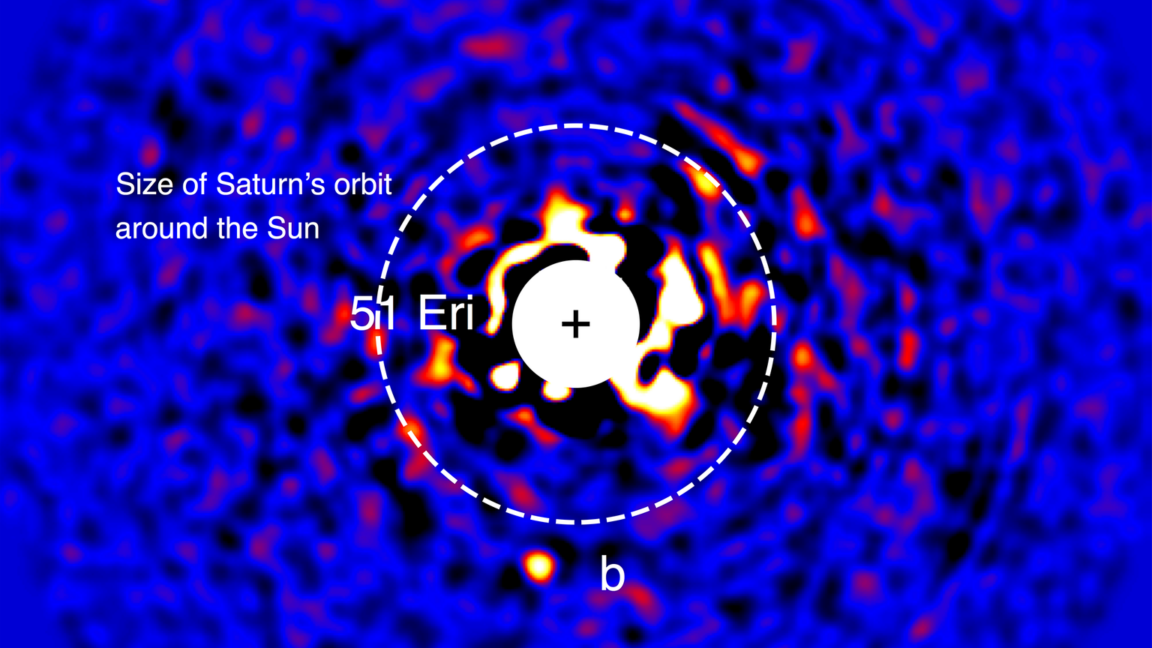
To evaluate the effectiveness of FLIP, the team analyzed observations from three stars: HIP 65426 and 51 Eridani, both with known exoplanets, and TYC 5899, which has no confirmed exoplanets but exhibits significant variability. Notably, these stars are relatively young, with some hosting massive planets that are still warm from formation, making them ideal candidates for imaging.
Utilizing data from the James Webb Space Telescope, the FLIP methodology demonstrated impressive results. The researchers reported an enhancement of the signal-to-noise ratio by 1.5 to 2 times, depending on the specific observation. Notably, they identified a planet within the Webb data at a wavelength conducive to detecting carbon dioxide for the first time. In the case of TYC 5899, sensitivity improvements reached an astonishing factor of 15.
Broader Implications of FLIP
The potential applications of FLIP extend beyond observing known exoplanets. By reducing noise levels in astrophysical data, this approach could unveil fainter, older, and less massive planets previously obscured from detection. Furthermore, the researchers plan to adapt FLIP to highlight the most impactful changes made to the model, providing insights into the operational status of the telescope’s hardware.
