


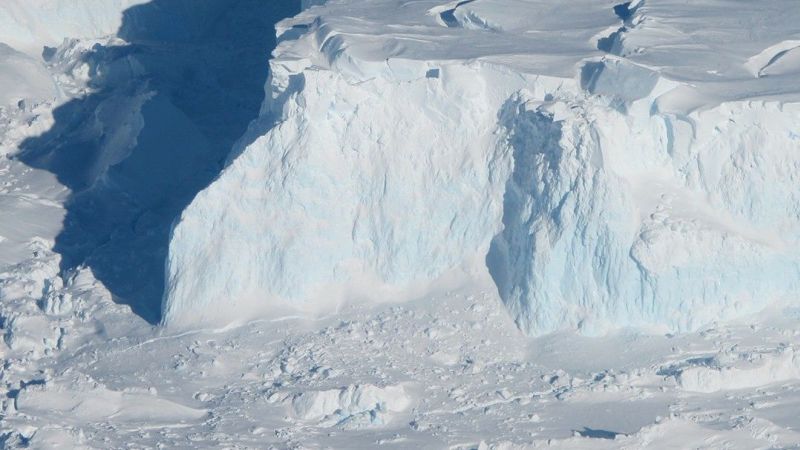
New Research Unveils Accelerated Melting of Thwaites Glacier: Potential Impacts on Global Sea Level Rise
Recent findings by glaciologists highlight that Thwaites Glacier in West Antarctica is melting at an alarming rate, potentially contributing to global sea level rise at twice the previously estimated rate. This glacier, often referred to as the “Doomsday Glacier,” is crucial in understanding future sea level projections.
Understanding Thwaites Glacier
With an expanse comparable to Florida, Thwaites Glacier has been in a state of retreat for decades. Currently, its melting contributes approximately 4% to the global sea level rise. However, the intricate mechanisms driving its retreat pose challenges for accurate predictions about its future behavior.
Thwaites Glacier is significant not only for its current contributions to sea levels but also because its complete collapse could lead to an increase of more than 2 feet in sea levels. As it acts as a barrier for the expansive Antarctic ice sheet, its destabilization could ultimately trigger a rise of up to 10 feet, imperiling coastal communities worldwide.
New Modeling Techniques Reveal Heightened Risks
Researchers from the University of California, Irvine and NASA’s Jet Propulsion Laboratory have implemented an innovative ice sheet model that offers clearer insights into the behaviors occurring beneath the glacier. Specifically, the model refines the understanding of the “grounding line”—where the glacier transitions from resting on the seabed to floating.
This evolving perspective acknowledges the grounding line as a more dynamic “grounding zone,” subject to tides that enable warm seawater to intrude beneath the ice, leading to accelerated melting—a phenomenon known as “tidal pumping.” According to lead author Mattia Poinelli, this increased warmth at the grounding zone has significant implications for the glacier’s stability.
Implications for Sea Level Rise
By recalibrating their models to incorporate tidal dynamics, researchers predict that Thwaites could account for an additional 1.2 inches of sea level rise by 2100, even in the absence of further climate warming. This revised estimate suggests that the potential impacts of Thwaites on global sea levels may have been greatly underestimated.
The topography underneath the glacier complicates the situation further. With the land sloping downwards, the melting process exposes more ice to warm ocean water, while two major underwater ridges help to hold back the ice temporarily.
The study reveals a 60% likelihood that melting processes may lead to the glacier losing its grip on one of these ridges, known as the Mouginot Ridge, by the end of this century. Following this unpinning, the glacier could quickly move toward another ridge, thus accelerating its retreat.
Increased Coastal Flooding Risks
Although a rise of 1.2 inches might seem minor, experts warn that even small increases in sea level can exacerbate risks of coastal flooding. “The results predict greater risk of and exposure for coastal flooding than anticipated in the coming decades,” noted Eric Rignot, a professor of Earth System Science at UC Irvine and co-author of the study.
Ted Scambos, a senior research scientist at the University of Colorado Boulder, emphasized that these findings represent a potential paradigm shift in forecasting sea level changes related to Thwaites. He, along with other researchers, indicates the need for more extensive study of grounding zone melting processes to derive precise predictions regarding ice loss.
Future Research Directions
Going forward, additional observational data is essential to better understand the glacier’s grounding line dynamics. The research team is scheduled to conduct a field study in 2028 to deploy instruments capable of measuring seawater movements beneath the ice.
As they prepare for this expedition, Rignot stresses that while climate change impacts on ice sheets have been observed for years, the emerging understanding of underwater glacier behaviors is heightening concerns about potential future outcomes. Despite efforts to reduce greenhouse gas emissions, he warns that the damages inflicted thus far will likely result in increased sea levels in the years to come.
In conclusion, ongoing research is vital to determine the full scope of Thwaites Glacier’s retreat and its implications for global sea levels, underscoring the importance of immediate action to mitigate climate change impacts.
