



Robinhood Markets Inc. (HOOD -7.21%) has carved a niche in the investment landscape by offering a platform for trading stocks, options, cryptocurrencies, futures contracts, and even prediction market event contracts. Despite reaching a peak price of $152.46 last year, the company has since experienced a significant downturn, with shares dropping approximately 40%, raising concerns about its future growth potential.
While a diversified investment strategy involving a holding of at least 50 stocks is often advised for long-term wealth accumulation, many Robinhood users lean towards short-term trading approaches. This can frequently lead to substantial losses.
Recent financial results underscore this trend. Robinhood reported $1.4 billion in revenue for the third quarter, marking a 12% increase year-over-year. Notably, revenues from options trading accounted for $399 million—over three times the income generated from stock trades. Such reliance on options trading could pose challenges for the company moving forward, particularly in a fluctuating market.
Image source: The Motley Fool.
Challenging Risks Ahead for Robinhood
Robinhood’s revenue growth appears promising at first glance, but the underlying volatility in its business model raises concerns. The company’s revenue streams heavily skew towards transaction-based income, which amounted to $867 million in the last quarter. A significant portion of this, $399 million, stemmed from options trading, which reflects the risky betting behavior prevalent among its retail clientele. Meanwhile, the company’s cryptocurrency revenue saw a sharp decline of 55%, totaling just $120 million.
Retail traders commonly utilize options for high-risk, short-term speculation. While this strategy may yield profits in bullish markets, historical data shows that many retail investors ultimately incur losses when trading these derivatives over extended periods. Such patterns can severely impact Robinhood’s revenue, especially if adverse market conditions occur.
Past performance suggests a repeating narrative: in Q2 2021, options and crypto trading revenues peaked but subsequently plummeted by 31% and 75%, respectively, a year later, leading to a drastic 90% fall in the company’s stock price.
Current Valuation and Future Outlook
Despite a notable decline of 40% from its previous highs, Robinhood’s stock still commands a price-to-sales (P/S) ratio of 16.7, exceeding its historical average of 12.3 since its public listing in 2021. This suggests that the stock may still be overvalued, with a potential need for a further 26% drop to align with historical averages.
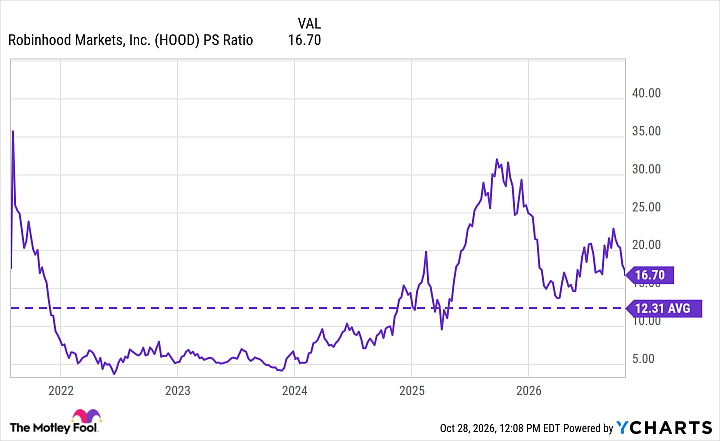
HOOD P/S Ratio data by YCharts.
Should options trading revenues significantly drop as they did after previous market peaks, this elevated P/S ratio could lead to an even steeper decline in stock value. Conversely, rising interest rates could bolster Robinhood’s net interest income—a key revenue source from margin lending and client cash holdings—providing some cushion against declines in transaction revenue.
In conclusion, while Robinhood has introduced new avenues of revenue, including predictive market offerings, the reliance on high-risk trading activities remains a significant risk. As the financial landscape evolves, investors may wish to exercise caution regarding the long-term potential of Robinhood’s stock, particularly under current market conditions.
