


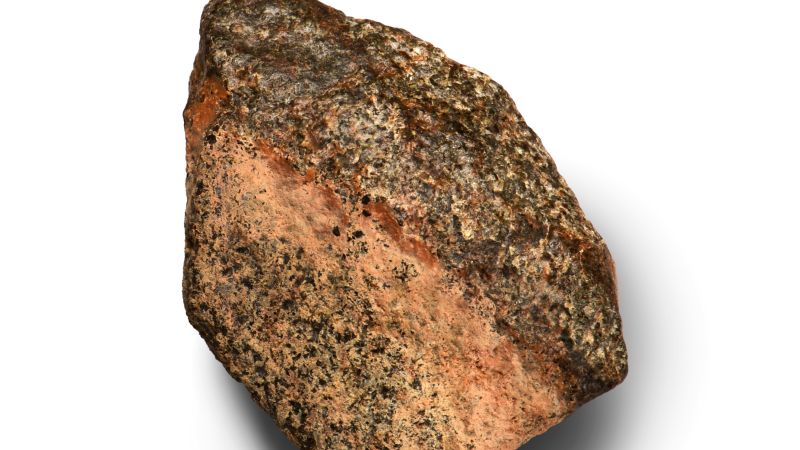
Teghaza 001: An Ancient Martian Meteorite Reveals the Red Planet’s Secrets
Recent scientific investigations have led to the discovery of Teghaza 001, one of the oldest Martian meteorites found on Earth, which provides significant insights into Mars’ primordial history. This unique rock displays evidence that liquid water influenced its crust more than 4.1 billion years ago.
A Rare Find from Mars
Identified as a rose-colored meteorite, Teghaza 001 exhibits a distinctive chemical makeup that distinguishes it from previously analyzed Martian samples. “This is a very rare, ancient Martian meteorite, and it gives us a chance to look at the early crust and mantle of Mars, at a time when life was just starting on Earth,” stated Yang Liu, a planetary scientist at NASA’s Jet Propulsion Laboratory and lead author of the study published in the journal Science on October 29.
Formation and Discovery
Teghaza 001 is believed to have originated from magma derived from the Martian mantle, later contributing to the surface crust. Liu notes, “The chemistry of this sample shows it comes from a Martian crustal area we have not sampled before.” Discovered in 2022 by meteorite hunters in Mali, the specimen is made up of eight fragments collectively weighing 798.5 grams (1.76 pounds), with the largest piece weighing 442 grams (0.97 pounds).
The Journey Through Space
This meteorite became dislodged from Mars due to an asteroid or comet impact, overcoming the planet’s weak gravity to enter space. After potentially orbiting the sun for millions of years, Teghaza 001 was eventually captured by Earth’s gravitational pull. Liu speculates that it may have remained in a desert environment for a prolonged period prior to its retrieval.
Scientific Significance
“It is always nice to see a new visitor from Mars, and this one is ancient — older than any home-grown Earth rock,” remarked Matthew Genge, an associate professor at Imperial College London, who was not involved in the research. Genge emphasized the meteorite’s age, likening it to a window into the formative stages of Mars, a time when liquid water is believed to have existed on the surface.
Advanced Analytical Techniques
Initially, Teghaza 001 did not seem particularly ancient, prompting Liu to consider passing on the study. The rock was classified as a shergottite, the most common type of Martian meteorite found on Earth. However, upon discovering zircon crystals within the sample—signifying a much older formation—Liu proceeded with the analysis. These crystals act as geological time capsules, allowing precise dating of the rock.
Innovative Dating Methods
Analysis of the zircon revealed the meteorite’s age to be at least 4.1 billion years, which indicates its formation occurred within the first 400 million years of Mars’ history. This dating was further verified through a novel method developed by Hayward Melton, a doctoral student at the California Institute of Technology, which employs a laser to analyze fine areas of the sample, thus expediting the dating process while preserving material for additional studies.
Teghaza 001’s Unique Composition
Classified as a basalt similar to terrestrial oceanic rocks, Teghaza 001 showcases a chemical composition that indicates prior interactions with water. This finding may aid researchers in understanding early Martian conditions and provide insights into the reasons behind Mars’ dryness compared to Earth’s continued habitability.
Geological Insights
Besides its unique mineral composition, which includes two calcium-rich minerals in unprecedented proportions, Teghaza 001 also possesses oxygen isotopes unlike those found in other Martian samples. Such distinct features establish a connection to the ancient Martian crust.
Mapping Martian Origins
Researchers have traced the mineralogical fingerprint of Teghaza 001 to 13 potential locations on Mars’ southern highlands from where it may have originated. Liu anticipates continued interest from the scientific community in this meteorite, which she believes will lead to further significant discoveries.
Conclusion
Darryl Pitt, a meteorite collector and advocate for the acquisition of Teghaza 001, highlighted the rock’s unusual mineralogy and age as key elements in its potential for yielding new findings. “What is truly remarkable about Teghaza 001 is that it allows us not only to be able to study another planet,” Genge noted. “But also to peer deep under its surface to see what the planet was like only 500 million years after it formed.”
