


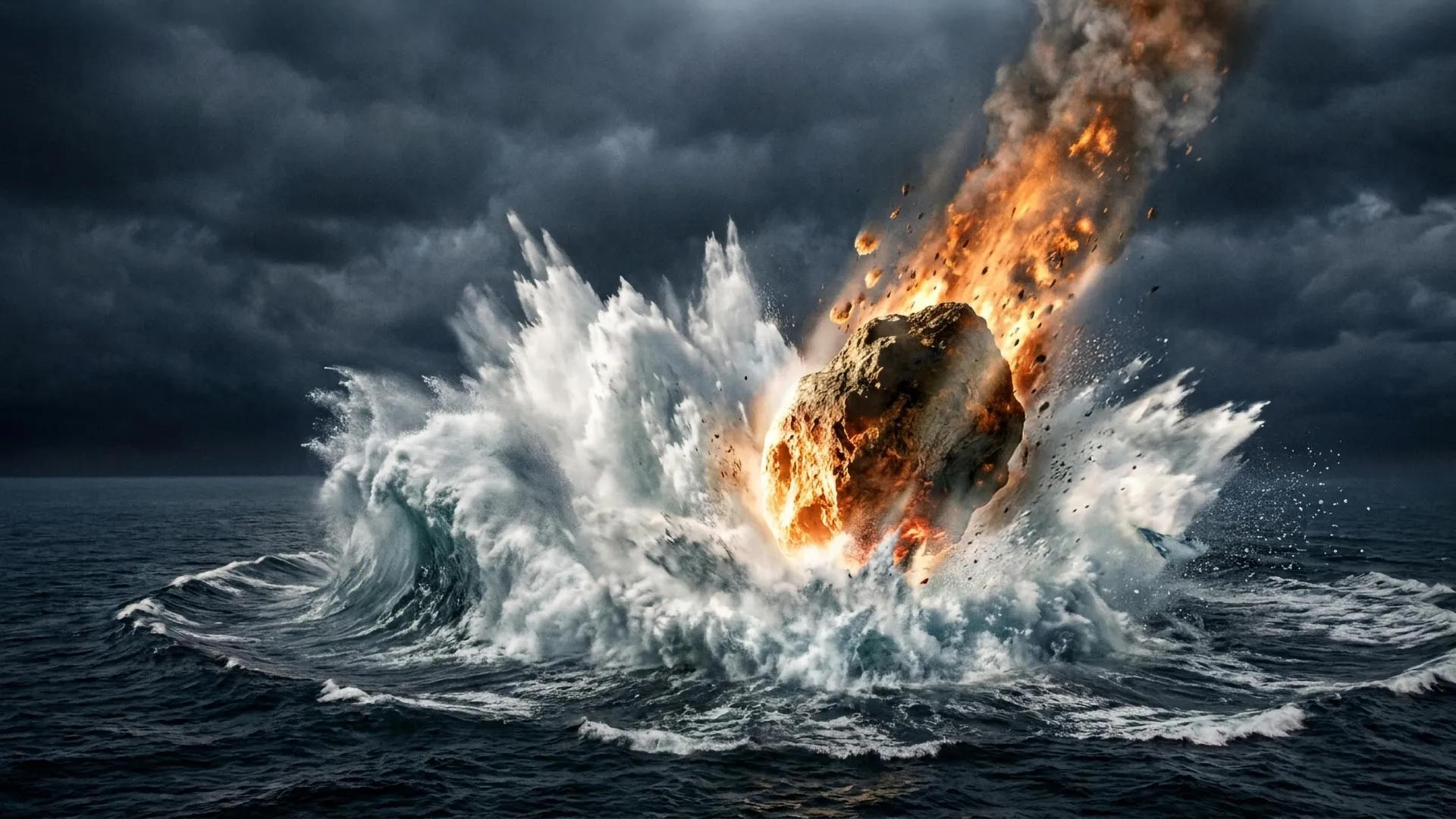
New Evidence Unveils Origins of Silverpit Crater in the North Sea
A groundbreaking study has confirmed a significant geological event from approximately 43 to 46 million years ago: the impact of a massive asteroid in the North Sea. This collision not only created the Silverpit Crater, which lies hidden beneath the seabed but also unleashed a towering tsunami estimated to exceed 100 meters (330 feet) in height.
Understanding Silverpit Crater
The Silverpit Crater, located around 700 meters below the surface of the southern North Sea, measures about three kilometers across and is encircled by a broader region of circular faults. Although first identified in 2002, the origins of this formation were long contested. Some scientists attributed its creation to geological forces rather than an extraterrestrial impact.
Advancements Leading to Confirmation
A team of researchers spearheaded by Dr. Uisdean Nicholson from Heriot-Watt University has provided robust evidence that Silverpit was indeed formed by an asteroid or comet impact. Utilizing advanced seismic imaging techniques, microscopic analysis of rock samples, and computer simulations, the team was able to reconstruct the collision dynamic and identify unique minerals formed under extreme conditions.
Key Findings and Methodology
The findings, published in Nature Communications, describe how the new seismic imaging allowed for an in-depth examination of the crater’s internal structure. The most compelling evidence came from the discovery of “shocked” quartz and feldspar crystals within rock samples extracted from nearby oil wells. Dr. Nicholson remarked: “These prove the impact crater hypothesis beyond doubt, because they have a fabric that can only be created by extreme shock pressures.”
Why Shocked Minerals Matter
- Unique Formation: Shocked minerals demonstrate structural changes from intense pressure typically found only after high-velocity impacts.
- Physical Evidence: Their presence at the depth matching the crater floor bolsters the case for an asteroid impact occurring at Silverpit.
The Tsunami Aftermath
Following the confirmation of the crater’s formation, researchers utilized numerical models to simulate the impact event. These simulations suggest that a 160-meter-wide asteroid struck the seabed at a shallow angle, leading to violent displacements of water and debris and producing a catastrophic tsunami.
Tsunami Characteristics
According to Dr. Nicholson, the asteroid impact generated a tsunami that reached heights of approximately 1.5 kilometers (about 0.93 miles), far surpassing typical waves caused by other natural disturbances. “Within minutes, it created a 1.5-kilometer-high curtain of rock and water that then collapsed into the sea,” Dr. Nicholson explained. This wave was taller than most high-rise buildings, showcasing the impact’s severity.
A Resolution to Long-Standing Debate
The study not only validates the asteroid impact theory but also concludes a prolonged scientific debate that has persisted for over two decades. Professor Gareth Collins from Imperial College London stated that “the discovery brings a satisfying conclusion” to the controversy surrounding Silverpit’s origins.
The Significance of Silverpit
Silverpit represents a rare opportunity for scientists to study an ancient impact site. The preservation of this crater allows researchers to analyze how high-energy impacts deform geological formations. Dr. Nicholson noted that, “around 200 confirmed impact craters exist on land, and only about 33 have been identified beneath the ocean,” making Silverpit a vital site for understanding the history of asteroid impacts on Earth.
Conclusion
The ongoing research into the Silverpit Crater not only enriches our understanding of Earth’s past but also aids scientists in predicting the potential impact of future asteroid collisions. As one of the few well-preserved impact sites, it offers invaluable insight into the dynamics of cosmic collisions and their geological consequences.
For more information, visit Nature Communications.
