


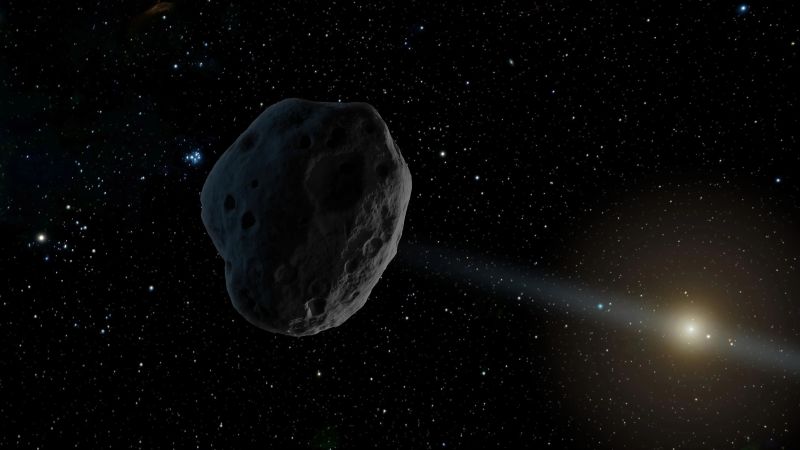
Earth’s New Mini-Moon: A Brief Companion in Orbit
In an event that has piqued the interest of astronomers and space enthusiasts alike, Earth is currently hosting a temporary second moon, designated 2026 QQ8. Captured by our planet’s gravitational pull in April, this small asteroid measures approximately 2 meters (6 feet) in diameter.
A Brief Sojourn
This “mini-moon” is expected to remain in orbit around Earth until early December, after which it will drift away, continuing its journey around the sun. Its transient nature is typical for such celestial objects.
Discovery and Confirmation
The journey to confirming 2026 QQ8 as a natural object took several weeks, as the asteroid’s diminutive size and low brightness initially led astronomers to consider other possibilities, such as a derelict satellite. The International Astronomical Union’s Minor Planet Center eventually designated it 2026 QQ8 in late October.
Mini-Moons: Not an Uncommon Phenomenon
The term “mini-moon” is not an official classification but has previously been used informally to describe similar small bodies that briefly orbit Earth. Notable examples include 2006 RH120, which orbited our planet for about a year, and 2020 CD3, which stayed for roughly three years. According to Matthew Payne, director of the Minor Planet Center, such temporary companions to Earth are not unusual: “On average, there’s probably one there at any given time.” These mini-moons can linger for a few weeks or months and can vary in number.
Challenges of Detection
Tracking these mini-moons presents challenges for astronomers due to their small sizes, coupled with their rapid movements across the sky. The vast majority of these objects tend to evade current observational surveys, making the catalog of such transient visitors relatively limited. “A lot of the time they’re slightly too far away and they’re also whizzing around quite fast from our point of view, and both of those things make it really difficult for current surveys to see them,” explained Payne.
Safety Assessment
For those concerned about potential impacts, there is no need for alarm regarding 2026 QQ8. Its small size means that, even if it were to enter Earth’s atmosphere, it would disintegrate harmlessly. As Payne noted, “At best, you would get a bright meteor in the sky and a bit of a bang.”
Journey of Discovery
The asteroid was initially detected by astronomer Krisztián Sárneczky in August and was provisionally named Sar2901. Sárneczky, a research coordinator at Hungary’s Konkoly Observatory, noted that its unique characteristics only became apparent after careful orbital calculations were conducted.
Understanding Near-Earth Objects
Objects like 2026 QQ8 fall under the broader category of Near-Earth Objects (NEOs), defined as celestial bodies with orbits that bring them near Earth. NEOs can include both asteroids and comets, with 40,000 NEOs identified to date. Most of these bodies originate from the asteroid belt located between Mars and Jupiter.
The Future of Discovery
In efforts to identify more such objects, the Vera C. Rubin Observatory in Chile is conducting a ten-year survey known as the Legacy Survey of Space and Time (LSST). Utilizing the world’s largest digital camera, the observatory aims to greatly enhance the rate of asteroid, comet, and galaxy discoveries. Payne anticipates a significant increase in the number of known celestial objects, stating, “The expectation is that we’ll go from knowing 1.5 million objects to knowing 5 million.”
As our understanding of these celestial companions expands, the identification and monitoring of mini-moons promise to reveal more about the dynamics of our solar system and the nature of its transient visitors.
