


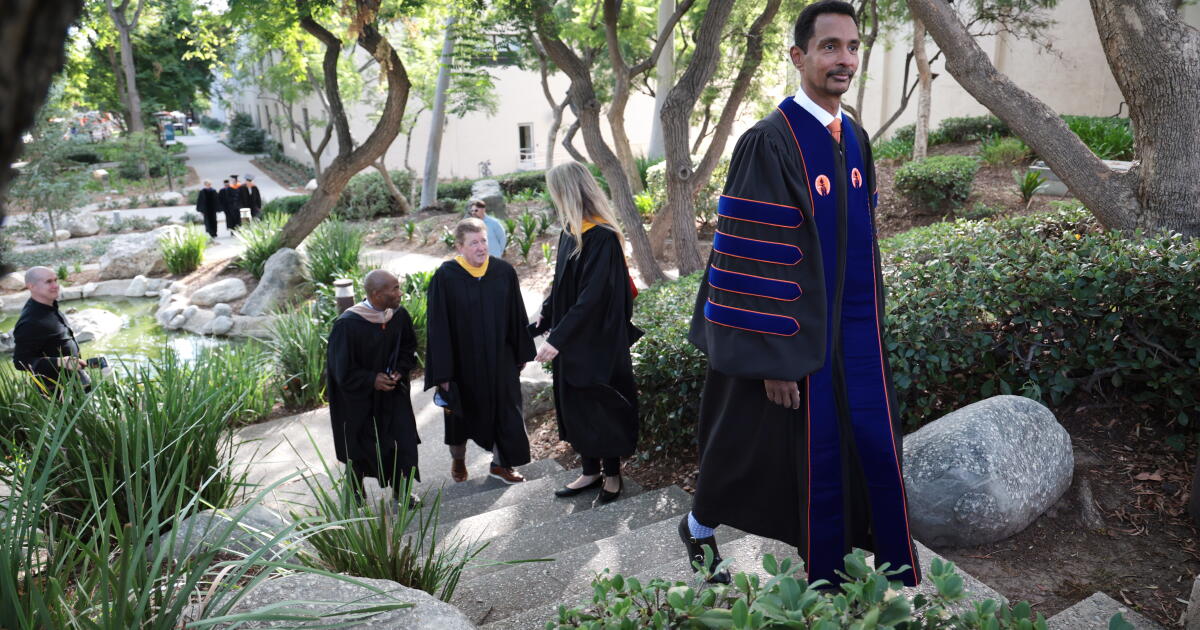
Ray Jayawardhana Takes Office as Caltech’s 10th President
Ray Jayawardhana, an astrophysicist known for his work on distant planets and extraterrestrial life, has been installed as the 10th president of the California Institute of Technology (Caltech). His journey into science began in his adolescent years in Sri Lanka, when he reached out to NASA’s Jet Propulsion Laboratory (JPL) and received a booklet featuring stunning images of Jupiter and Saturn.
Significant Background and Accomplishments
Caltech holds a prestigious reputation, being the birthplace of JPL and responsible for many advancements in science, including the Richter scale for measuring earthquakes and the pioneering research that led to the detection of cosmic gravitational waves. The institute has produced 49 Nobel laureates among its alumni, faculty, and postdocs.
Facing New Challenges
In an interview with The Times, Jayawardhana, age 55, discussed the challenges faced by Caltech, including its partnership with governmental entities amid fluctuating federal policies, the rise of artificial intelligence, and recent global events. He noted, “We must find clarity at a time of change and uncertainty.”
A particular point of contention is the management contract for JPL, which has been opened to competition for the first time since NASA’s inception in 1958. With potential competition from numerous institutions, including the University of California and Texas A&M, Caltech is navigating this unprecedented scenario carefully.
Caltech’s Commitment to Accountability
Jayawardhana emphasized the importance of universities to deliver value to taxpayers in return for their funding. He stated, “It’s time to renew that compact while also recognizing the ecosystem needs to evolve.” Caltech is currently facing scrutiny from the Labor Department over the use of J-1 visas for international scholars, which some allege may have been misused.
Looking Forward: Optimism Amid Challenges
Despite the challenges, Jayawardhana highlighted reasons for hope, particularly with the recent launch of NASA’s Roman Space Telescope and the progress of the PRIMA far-infrared telescope, which is projected to launch in 2033. Caltech has also garnered substantial donations, totaling around $73 million since his tenure began on July 1.
Describing the ethos of Caltech, which has a selective admission rate on par with Harvard, he stated, “We are really small but truly mighty.”
Innovative Approaches and Future Endeavors
Under Jayawardhana’s leadership, Caltech is redefining its operational strategies at JPL. A new framework now allows private entities and nonprofits to fund projects directly, which has already generated $50 million for ongoing work within a short time frame.
Additionally, Jayawardhana announced key appointments and generous contributions from benefactors, highlighting ongoing support for aerospace research initiatives.
Responses to Contemporary Issues
This fall, debates surrounding artificial intelligence came to the forefront at Caltech, especially regarding a student-driven initiative that encountered backlash from faculty members concerned about the implications of AI in mathematics. Jayawardhana commented on the evolving role of AI, pointing out that the scientific process will inevitably shift with its growing integration.
Moreover, he is committed to a stance of institutional neutrality on social and political issues, supporting the principle that accommodating diverse viewpoints does not equate to endorsing them.
A Lifelong Passion for Astronomy
Jayawardhana’s fascination with space began in childhood, inspired by conversations with his late father. He holds degrees from notable institutions such as Yale and Harvard and has served in various academic capacities before joining Johns Hopkins in 2023. His work continues to focus on the search for habitable planets, as he encourages explorations beyond Earth.
He stated, “The universe is a big, big, big place, and it would be presumptuous, to say the least, to imagine that life originated only on one little rock around one rather ordinary star.” Jayawardhana believes that confirming extraterrestrial life would be monumental for humanity, akin to the historical impacts of Darwin or Galileo.
