


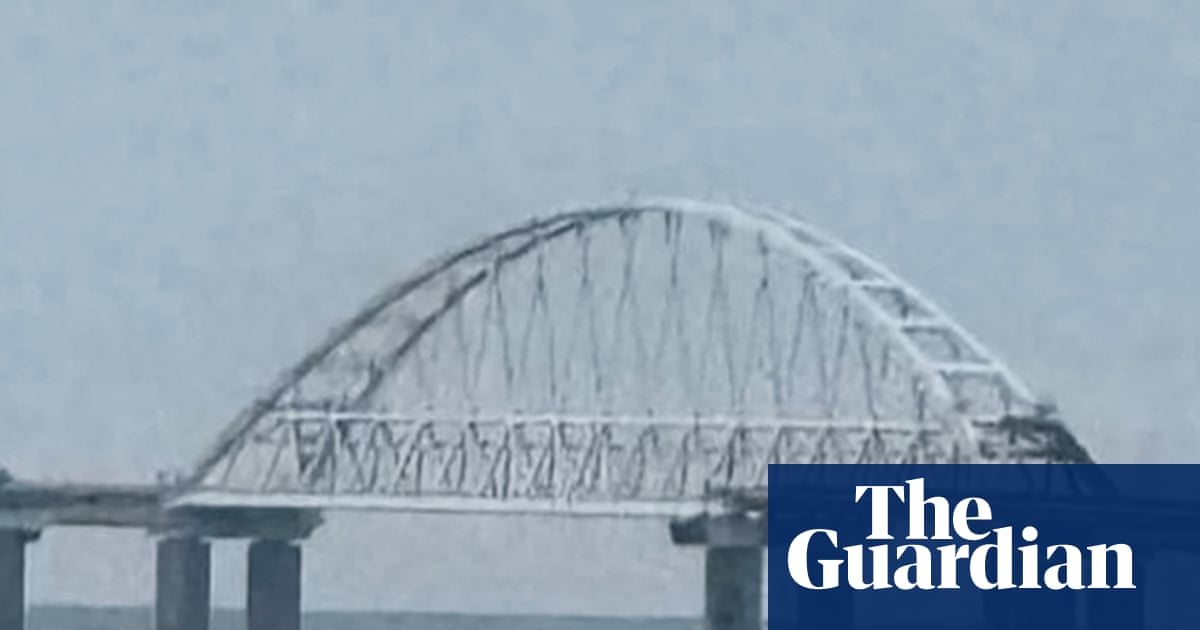
Ukraine’s Strategic Drone Attack on the Kerch Bridge
On a chilly Monday night, a Ukrainian soldier inscribed a potent message on a kamikaze drone: “The bridge is fucked. We will stand and Moscow will fall.” This declaration set the stage for a significant military operation aimed at a structure central to Russian President Vladimir Putin’s vision for Crimea, located approximately 500 kilometers south of the soldiers’ position.
The Context of the Operation
Typically, the Ukrainian forces had been targeting oil refineries deep within Russian territory, a task that had become almost routine. However, the objective on this particular night represented a distinct mission—one that resonated deeply with the warriors due to its symbolic connection to Putin’s aspirations.
“We knew what the target was. Everyone was enthusiastic and excited,” revealed a participant in the operation, using the pseudonym “Leon.” As a member of the 7th Deep Strike Centre under “Magyar’s Birds,” a brigade led by Robert Brovdi, Leon expressed that this mission differed greatly from their typical assignments. “Nobody gets excited anymore about oil refineries. This was different,” he stated.
Launch and Execution of the Attack
As preparations commenced, soldiers anxiously anticipated the launch of the drone, which was heavily laden with explosives. The biplane-like drone soon vanished across the expansive southern Ukrainian landscape, marking the start of coordinated operations that would unfold over the ensuing hours.
Wave After Wave of Drones
Over a four-hour window, numerous attack drones took flight, following a linear path before veering out over the Black Sea towards their target—the Kerch Bridge. This bridge, inaugurated by Putin in 2018 amidst the backdrop of the illegal annexation of Crimea, had become a symbol of Russian dominance over the region. For Ukraine, it represented an emblem of defiance against what they deemed Russian imperialism.
Despite claims from Russian propagandists labeling the bridge as “impregnable,” Ukrainian sources noted that the bridge had been the target of previous unsuccessful attack attempts. The multi-phase military strategy utilized in this operation exemplified Ukraine’s adaptive approach to warfare, aiming to saturate Russian air defenses before launching direct assaults on the bridge itself.
Technological Innovations and Strategy
According to Leon, the operation was meticulously planned. “It was a well-coordinated operation,” he explained, describing how waves of drones were unleashed from various locations to distract and overwhelm Russia’s organized aerial defenses.
The assault was facilitated by advancements in drone technology, with Ukraine reportedly having set up its own real-time communication system, circumventing limitations imposed on drone speeds—set at a maximum of 161 km/h—after recent adjustments by SpaceX concerning their satellite services.
Flamingo Missiles and Impact
Once communication networks were established, a follow-up attack utilized the Ukrainian-made Flamingo missiles, each designed to carry significant payloads. Reports suggest that several missiles were launched towards Crimea, culminating in impactful strikes on the bridge.
Visual records from the attack captured a dramatic sequence as one missile approached the bridge, where the eventual explosion illuminated the night sky, resulting in substantial damage.
Consequences and Implications
By early Tuesday morning, images emerged showing the aftermath: portions of the bridge collapsed into the Kerch Strait, blocking crucial transit routes for Russian forces. The destruction of this vital structure has significant operational implications for Russia’s military, which has relied on the bridge for logistical support to its forces stationed in Crimea.
“We have disrupted their logistics to Crimea. There will be a lot of problems for Russia’s army in the south,” Leon predicted. The impacts extend beyond logistical hurdles; with the Kersh Strait’s shipping lanes obstructed, trade routes and military operations could face serious delays.
A Symbolic Victory for Ukraine
This successful operation was hailed by Ukrainian officials, including President Volodymyr Zelenskyy, as a symbol of resilience. The timing of the attack suggested strategic intent, occurring just before a significant summit involving international leaders including Xi Jinping and Donald Trump, aiming to demonstrate that Russia’s display of strength was more facade than reality. “What we did shows the world that the king is nude. Putin is weak and vulnerable, and we just proved it,” one Ukrainian military source asserted.
Conclusion
In summary, the drone assault on the Kerch Bridge underscored Ukraine’s evolving military capabilities and its tactical ingenuity in undermining Russia’s logistical and symbolic strongholds. As both sides react to the consequences of this engagement, the unfolding developments may shape the future of the ongoing conflict considerably.