


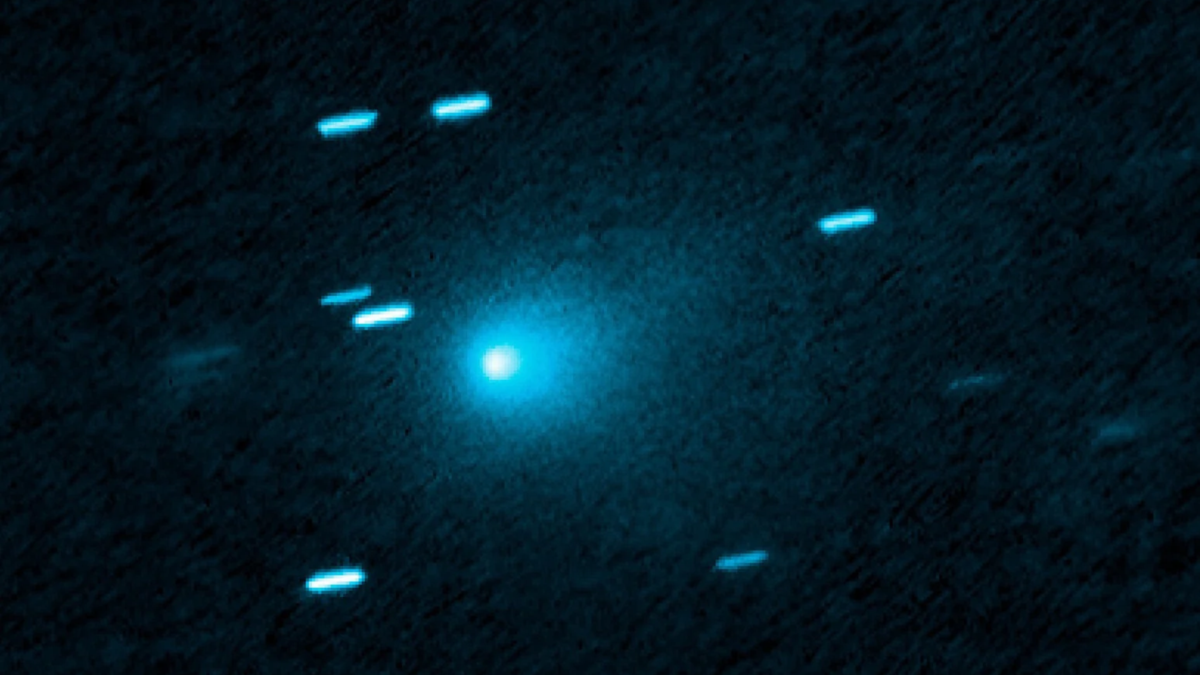
Comet 3I/ATLAS: An Ancient Cosmic Time Capsule
A Glimpse into Cosmic History
Comet 3I/ATLAS serves as a fascinating artifact from the cosmos, originating from a distant exosolar system and believed to have been ejected into the vastness of space due to a cataclysmic event. This interstellar wanderer, which may have been drifting for billions of years, provides a unique opportunity for scientists to study its primordial composition.
Catching a Ride on Solar Winds
As it approaches our Sun, 3I/ATLAS interacts with solar radiation, creating a visible atmosphere, also known as a coma. This process is likened to a sneeze in reaction to sunlight, as the comet releases its icy volatile substances. Such encounters are fortuitous for astronomers, who can analyze materials from an alien solar system potentially formed over 7 billion years ago.
Insights from Advanced Observations
A recent study published in Nature Astronomy details the findings of a team led by NASA Solar System Exploration scientists. Utilizing the advanced infrared capabilities of the James Webb Space Telescope, researchers examined the comet’s atmospheric emissions in late December 2025, while it traversed the asteroid belt.
Investigating Isotopic Ratios
The researchers specifically focused on the deuterium-to-hydrogen (D/H) ratio present in the comet’s methane, a crucial indicator of its chemical history. Findings revealed that 3I/ATLAS retained an exceptionally high amount of heavy methane compared to known Solar System bodies, notably containing 13 times more than comet 67P/Churyumov-Gerasimenko, which was thoroughly studied by the Rosetta spacecraft.
Unveiling Cosmic Origins
The unique D/H signature of the comet points toward its formation in a cold, low-metallicity environment, possibly within a protostellar disk around a nascent star. These regions, critical for understanding star formation, are notoriously challenging to study due to their dense chemical compositions.
The Significance of 3I/ATLAS
Comet 3I/ATLAS, now dubbed a “pristine sample” of interstellar chemistry, has been instrumental in addressing significant cosmic questions. Analyses suggest its formation occurred in a frigid region of space, enabling the preservation of unique isotopic ratios due to low temperatures, which favor the accumulation of deuterium relative to regular hydrogen.
Understanding the Early Universe
Furthermore, the low carbon-13 content found within 3I/ATLAS adds to the narrative of its ancient genesis, indicating it formed in an era when the universe was still relatively barren of heavier elements forged by stellar processes and supernovae. This offers an extraordinary window into cosmic evolution long before our own Solar System came into being.
Concluding Thoughts
The remarkable journey of comet 3I/ATLAS emphasizes the vast timelines within our universe. Its existence raises profound implications about cosmic history, suggesting that it may have traveled through space for 7 billion years before any of the material that makes up our Solar System was ever formed.
