


The Intriguing Dynamics of Mars: A Seasonal Dance of Ice and Sand
The Enigmatic Martian Landscape
Despite extensive exploration, Mars has long been considered a barren planet with no signs of life. Rovers and orbiters have yet to discover any living organisms, plants, or vegetation on its surface.
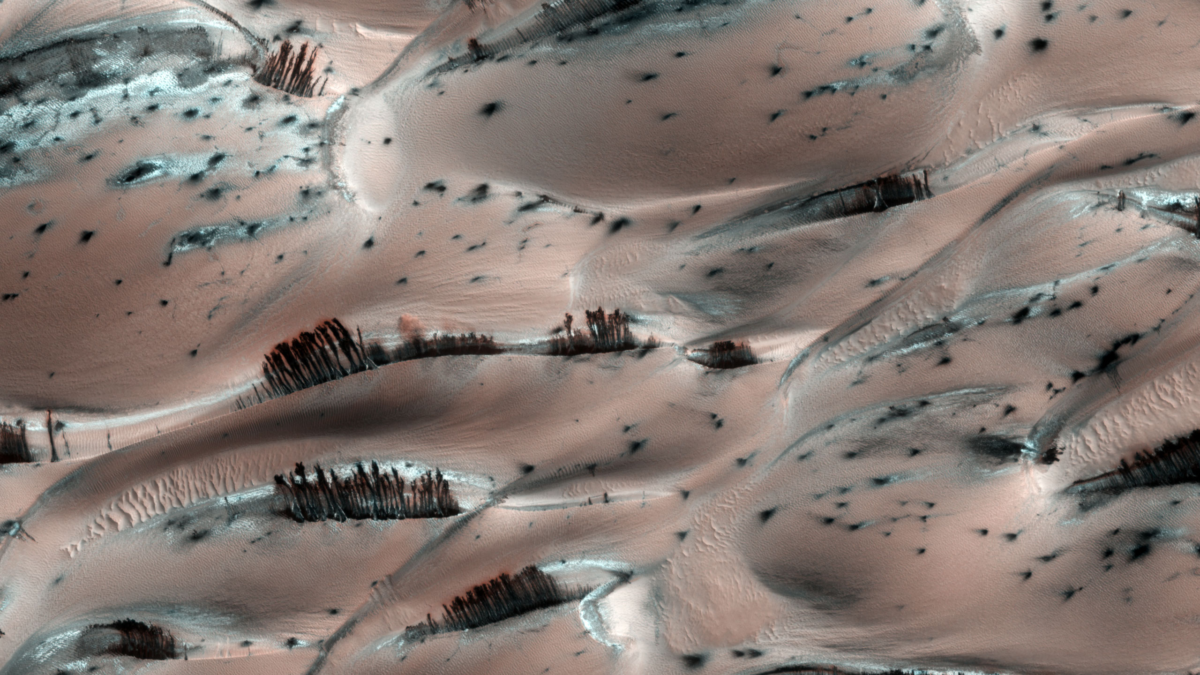
However, an image captured in 2008 by NASA’s Mars Reconnaissance Orbiter (MRO) has sparked intrigue. The photograph depicts what appears to be a forest of trees standing on the frozen dunes at the Martian north pole.
A Different Perspective: The Truth Behind the Image
Upon closer inspection, the portrayal of a Martian forest is a trick of perspective. When viewed upside down, the image reveals that the so-called “trees” are actually dark streaks of sand emerging from within the dunes, disturbed by the seasonal sublimation of carbon dioxide ice.
The Martian Seasons: A Unique Cycle
Similar to Earth, Mars experiences seasonal changes due to its axial tilt. However, the Martian seasonal processes differ significantly from those on our planet.
During the harsh Martian winter, carbon dioxide from the atmosphere freezes into frost and snow, covering the poles in what is known as dry ice. As spring approaches, this ice sublimates directly into the atmosphere, skipping the liquid phase.
This sublimation process has a profound effect on the Martian landscape, leading to a series of geological changes.
The Dynamics of Dune Formation
Even minimal sunlight can warm the ice on the slopes of Martian dunes, causing it to crack and weaken. Interestingly, this sunlight can penetrate the ice, leading to the formation of gas pockets below. When these pockets burst, they can propel sand down the dune slopes.
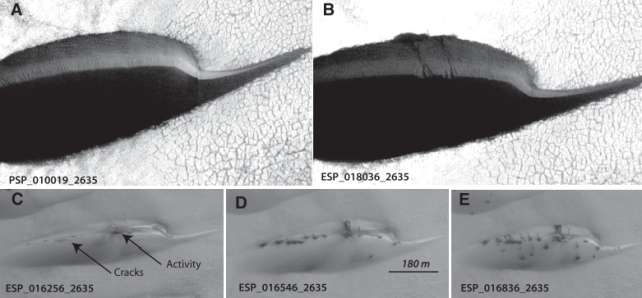
As the sand cascades down, it leaves behind dark streaks that resemble the shapes of trees when viewed from above. NASA’s HiRISE camera captured instances of dust clouds produced by sand movement, illustrating these dynamic changes.
Evolution of the Martian Landscape
A study conducted in 2011 by planetary scientist Candice Hansen-Koharcheck and her team highlighted the impact of seasonal changes on the Martian polar dunes. Their observations revealed that over a single Martian year, certain dunes advanced up to 4.7 meters, showcasing the ever-evolving landscape.
When summer arrives, the carbon dioxide ice vanishes, and the dark streaks disappear, reshaped by the Martian winds that smooth the dune surfaces.
As winter returns, these dunes are once again enveloped in ice, setting the stage for another cycle of striking patterns that evoke visions of a ghostly forest in a desolate alien landscape.
This article has been fact-checked and edited for accuracy. If you notice any discrepancies, please feel free to reach out.
