


Advancements in Cavity Quantum Electrodynamics and Their Impact on Quantum Technology
Cavity quantum electrodynamics (CQED) is a cutting-edge field that examines the interaction between light and matter within confined spaces. This article delves into the latest breakthroughs in CQED, focusing on its potential applications in quantum networks, many-body systems, and advanced quantum memory.
Understanding Cavity Quantum Electrodynamics
CQED investigates how photons interact with atoms or artificial quantum systems within a cavity. It draws on principles from quantum mechanics, enabling significant advancements in both fundamental research and practical applications. For instance, Walther et al. (2006) provided pivotal insights into the principles governing cavity quantum electrodynamics, discussing how these interactions can lead to phenomena such as superradiance and enhanced frequency control.
Recent Developments in Quantum Networks
The integration of single atoms with optical photons has catalyzed progress in quantum networking. Reiserer and Rempe (2015) outlined how cavity systems could be harnessed to form the backbone of quantum networks, where entangled states facilitate secure communication. A recent study by Knaut et al. (2024) further demonstrates practical implementations of this technology, showcasing entanglement achieved in nanophotonic quantum memory nodes, essential for creating robust quantum communication systems.
Entangled States and Many-Body Systems
The exploration of many-body systems is transforming our understanding of quantum mechanics. Research by Eisert et al. (2015) examined how quantum many-body systems behave when out of equilibrium, opening avenues to new phases of matter. Mivehvar et al. (2021) expanded on this by showing how cavity QED can provide novel frameworks for studying collective dynamics in quantum gases, indicating that such interactions could lead to emergent phenomena that redefine our current physics paradigms.
The Role of Superradiance
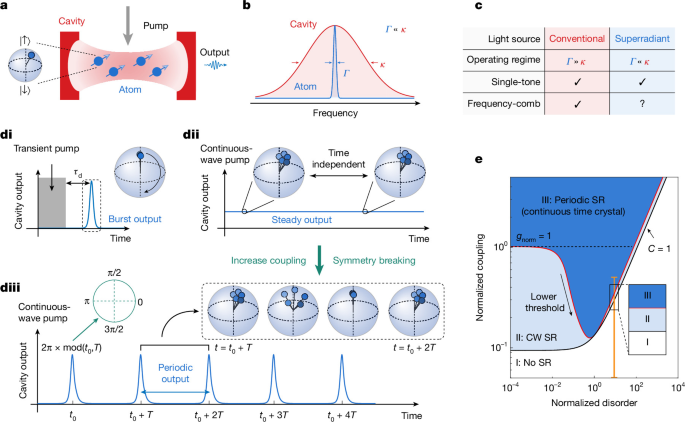
Superradiance, a phenomenon where photons emitted by a group of excited atoms display enhanced intensity, is a significant area of research in CQED. Groundbreaking studies by Gross and Haroche (1982) laid the theoretical foundation for understanding collective spontaneous emission. Advances by Bohnet et al. (2012) confirmed this phenomenon in practical setups, revealing the potential for creating lasers with exceptional characteristics.
New Frontiers in Time Crystals
Time crystals, systems that display periodic structure in time rather than space, have emerged as a fascinating area of study. Recent experiments have observed continuous time crystals, as reported by Kongkhambut et al. (2022), and various implementations demonstrate the robustness of these phases against perturbations. Wu et al. (2024) expanded on dissipative time crystals, showing how interactions in strongly correlated systems can lead to novel dynamical behaviors lacking equilibrium counterparts.
Future Directions of Quantum Technologies
CQED continues to pave the way for significant advancements in quantum technologies. Initiatives aiming to develop coherent quantum interfaces, such as those utilizing rare-earth ions for optical-frequency conversion (Wang et al., 2022), highlight the potential for creating highly effective quantum memories. Moreover, ongoing explorations into high-cooperativity systems signal a robust future for applications ranging from quantum computation to precision measurement strategies.
Conclusion
The developments in cavity quantum electrodynamics are crucial for the evolution of quantum technology. With ongoing research poised to unlock new capabilities in quantum networks, memory systems, and understanding of fundamental physics, the future looks promising. As science continues to bridge the gaps between theory and application, CQED stands as a fundamental pillar in realizing advanced quantum technologies.
For further detailed studies referenced in this report, please consult the following articles:
- Walther, H., et al. (2006) Rep. Progr. Phys. 69, 1325–1382.
- Reiserer, A. & Rempe, G. (2015) Rev. Mod. Phys. 87, 1379–1418.
- Knaut, C. M. et al. (2024) Nature 629, 573–578.
- Eisert, J., et al. (2015) Nat. Phys. 11, 124–130.
- Mivehvar, F. et al. (2021) Adv. Phys. 70, 1–153.
