


Astrophysicists Identify Strong Candidate for Microblazar
In a significant breakthrough, an international team of researchers has reported the strongest candidate for a “microblazar,” a cosmic entity long theorized but not yet documented. This discovery could provide valuable insights into the behavior of black holes that emit powerful jets of energy.
Understanding Blazars and Microblazars
Blazars are classified as some of the universe’s most energetic objects, falling within the category of quasars. These bright celestial bodies are powered by supermassive black holes that extract material from their host galaxies, ejecting this matter in twin jets of particles and radiation. To qualify as a blazar, at least one of these jets must be directed straight towards Earth.
In addition to blazars, astronomers have identified microquasars—smaller analogs of quasars. The existence of microblazars, which are similarly smaller variations of blazars, has been a topic of speculation among scientists.
Discovery of IRAS 18293-0941
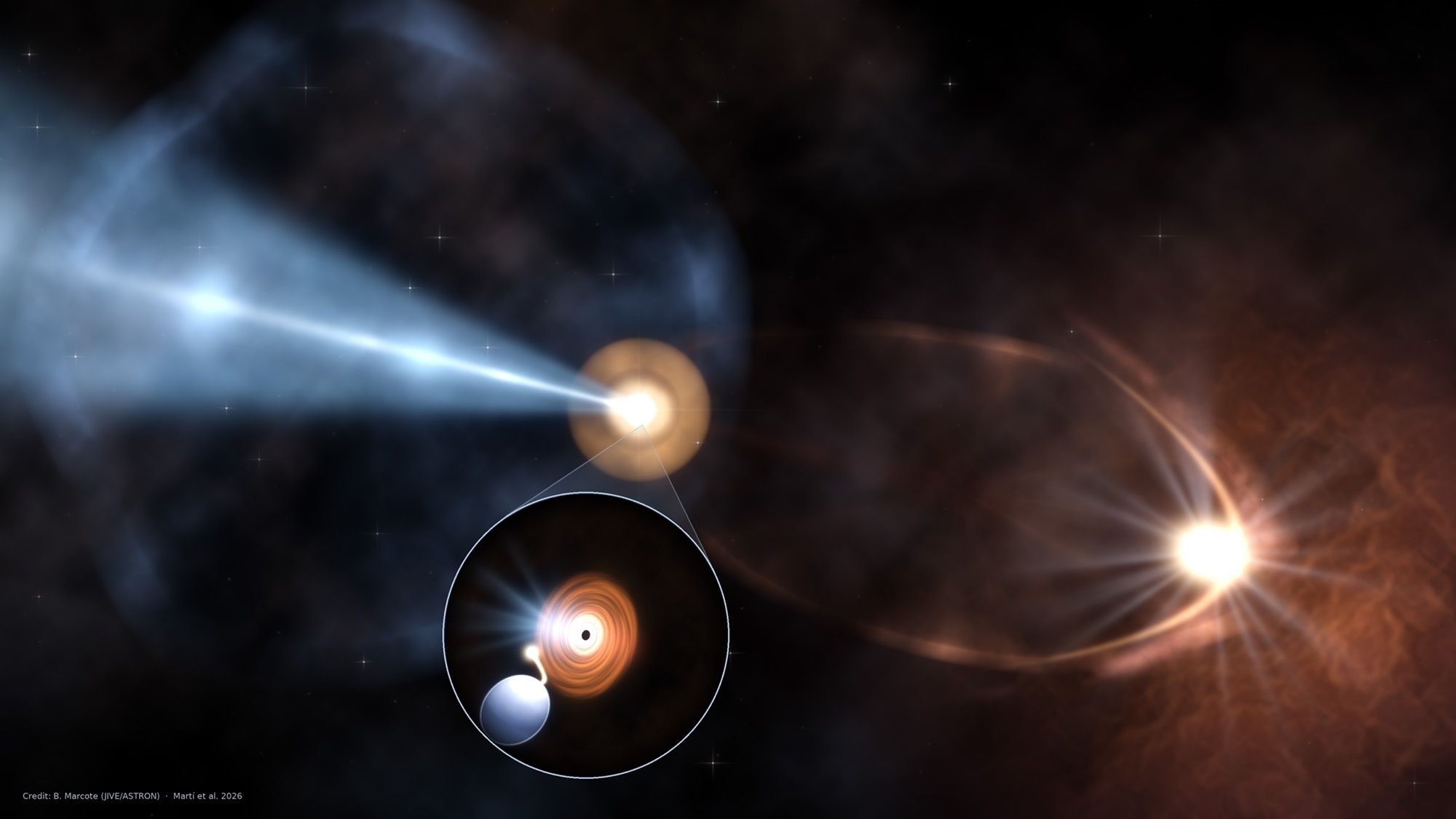
The newly studied object, designated IRAS 18293-0941, resides within our galaxy, approximately 12,000 light-years from Earth and obscured by dust. It is a binary system consisting of a black hole and a massive star in close orbit, taking only 11 days to complete one revolution. In this system, material from the gigantic star is siphoned into the black hole, with some of this material being ejected in two opposing jets—one of which is directed towards our planet.
“For the first time, we have a serious candidate for a microblazar,” stated Josep Martí, the lead researcher and an astronomer at the University of Jaén, Spain.
The Challenges of Observation
Observing microblazars poses significant challenges due to their fleeting nature in the cosmic timeline. Martí noted, “The microquasar phase of evolution is very short, making these systems difficult to identify.” Furthermore, the dense clouds of gas surrounding such objects can obscure critical features, complicating the observational process.
Key Characteristics and Observational Techniques
The team utilized multiple sophisticated instruments to study IRAS 18293-0941. This included resources from the Calar Alto Astronomical Observatory in Spain, the European VLBI Network of radio telescopes, the MeerKAT radio telescope array in South Africa, and archival data from the Very Large Array located in New Mexico.
IRAS 18293-0941 exhibited many of the expected characteristics of a microblazar, such as emissions across the electromagnetic spectrum and aspects indicating jet interactions with surrounding material. However, one anticipated feature was missing: rapid variability in brightness. Typically, microblazars show quick changes in brightness due to the Doppler boosting effect, which amplifies fluctuations when the jet is pointed at Earth. The absence of this rapid variability in IRAS 18293-0941 could be attributed to the dense gas enveloping it, which may mitigate quick brightness changes.
Expert Evaluations
Expert opinions on the study emphasize its significance despite the absence of one expected feature. Kinwah Wu, a theoretical astrophysicist at University College London, remarked that the findings are credible and based on sound assumptions. Svetlana Jorstad, a senior research scientist at Boston University, described the research as “very interesting, important, and comprehensive.” Furthermore, astronomer Itumeleng Monageng from the University of Cape Town highlighted the study as revealing key mechanisms that could account for some of the highest energy emissions observed in the universe.
Conclusion
The identification of IRAS 18293-0941 as a potential microblazar opens new avenues for research into high-energy astrophysical phenomena. With continued study, these microblazars may contribute to our understanding of some of the most powerful processes at play in the universe.
