


France’s Nationwide Protests: A Timeline of Unrest
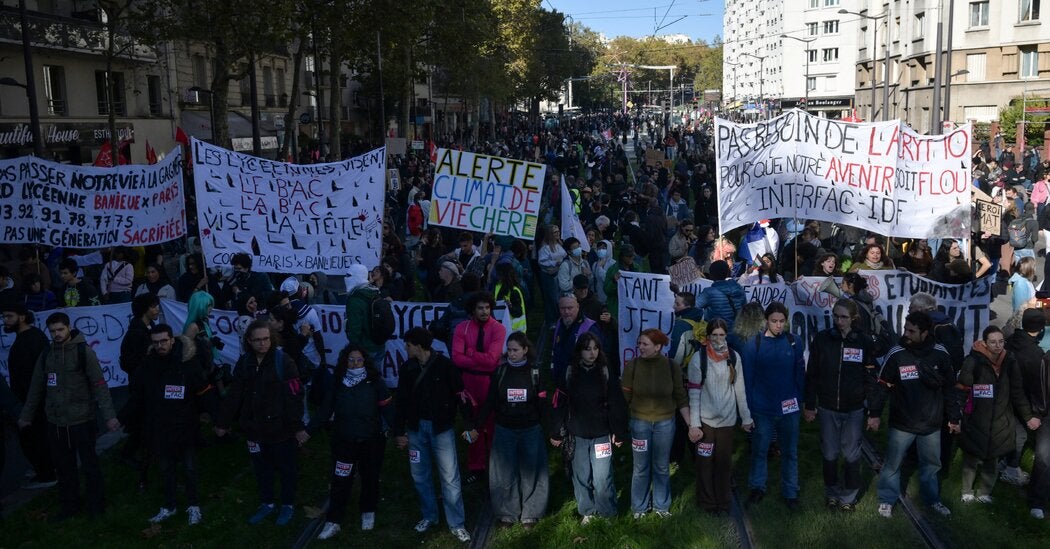
The political climate in France has become increasingly turbulent as protests initially led by high school students have expanded into a nationwide movement. What began in suburban Paris has quickly escalated into widespread demonstrations against various governmental policies and societal grievances.
Origins of the Protests
On September 18, 2023, students in the working-class suburb of Créteil organized a protest to voice concerns over insufficient educational resources and overwhelming workloads. This action marked the beginning of a series of similar demonstrations across the Paris region, particularly in poorer suburban areas. Students rallied against issues such as dilapidated infrastructures, crowded classrooms, and perceived flaws in higher education admissions.
Escalation of Unrest
By the end of September, protests had erupted in approximately 400 schools nationwide. The student union highlighted the lack of teachers and overcrowded educational environments as key issues. As the protests surged, students resorted to tactics like blocking school entrances with various obstacles and engaging in minor acts of vandalism. French Education Minister Édouard Geffray acknowledged some legitimacy in their demands but criticized the aggressive nature of the protests, which resulted in confrontations with authority figures.
Authorities reported nearly 80 injuries and over 440 arrests by the end of the month, including several minors.
University Student Involvement
The unrest grew to include university students as protests spread further in early October. By October 2, more than 1,000 schools were reportedly involved, with 220 on lockdown. Concerns arose that the nature of the protests transformed from educational grievances to civil disorder, with incidents of violence including projectile launching and arson.
Injuries among law enforcement personnel, school employees, and students approached 400, with arrests surpassing 3,000.
Wide-ranging Solidarity
During the same period, the protests gained momentum as labor unions and other activist groups joined in, uniting various causes under the banner of social justice. On October 6, approximately 256,000 demonstrators marched through Paris and other cities, with claims from student unions that nearly 1,800 high schools were occupied.
While many protests remained peaceful, confrontations with police did arise, leading to the use of tear gas in multiple cities. Reports indicated a rising count of arrests, with authorities citing up to 6,000 detentions.
Record Demonstrations
The protests reached their peak on October 17, 2023, drawing an estimated half a million participants to 110 marches across France. According to the General Confederation of Labor (C.G.T.), figures could be as high as 800,000. While many participants engaged peacefully, some took part in vandalism, leading to significant property damage across the nation. In Paris alone, rioters were reported to have caused destruction outside of authorized march zones, while significant property was damaged in cities like Limoges, where a historic City Hall was set ablaze.